The Archives Screen Examined
The ISAD(G) Tabs Examined
Identity Statement Tab
The Identity Statement tab is used to identify and describe the archival material represented by the record. Please enter a description for the item or group of items in the Scope and Content / Abstract field located on the left of this tab. To the right of the Scope and Content, you will find the fields Multilevel Linking, Title, Dates of Creation, Dates of Accumulation, and Extent and Medium of the Unit of Description.
Multilevel Linking Level of Description - The position of the item in the hierarchy of the fonds or collection. This may be Fonds/Collection, Series, Subseries, Folder, or Item. This will be explained further in the multilevel linking portion of this chapter.
Title - A word, phrase, character, or group of characters that names an archival item. When the material bears a formal title, transcribe it exactly as it is worded, ordered and spelled. When generating your own title, use a phrase that reflects function, activity, subject, location, or theme.
Dates of Creation - The actual date or range of dates during which the archival material was created. For example, 1916-1945.
Archives Catalog Identity Statement tab
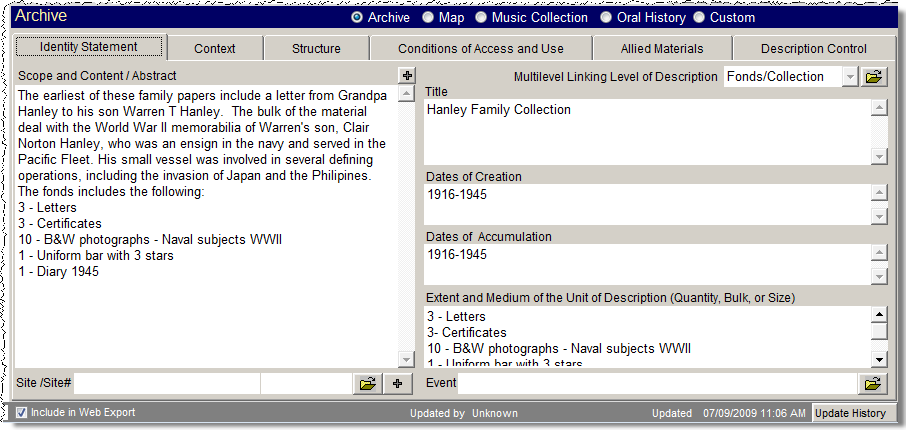
Dates of Accumulation - This date range can be different from the Dates of Creation. It is used to record the period over which the material has been accumulated by a collector.
Extent and Medium of the Unit of Description - Use this field to record the number of physical units in Arabic numerals and the unit of measurement. Alternatively, give the linear shelf space or cubic storage space occupied by the archival material. For example: "143 rolls of microfilm, 35 mm" or "100 cubic feet (65 boxes)." Please also record the type of material being described, such as "1 book, folded leather cover with 32 paper leaves."
Event - Use this field to refer to a named occasion associated with these materials. Using the file folder icon button, you can access the Event authority file to complete this field and learn the details recorded about this event.
Site/Site # - If this material is associated with a site, please record the site name and link it to your Sites & Localities record using the Site field. Use the plus sign button to the right of the field to link to additional sites.
The Context Tab
This tab is used to identify the creator of the archival material and place the material in context. This tab displays the Scope and Content and contains the following fields:
Name of Creator - Enter the name of the organization or individual responsible for the creation of the material. Notice the file folder icon to the right of this field. This indicates that there is a subscreen available where you may record biographical information about the creator. For both the Creator and Other Creators fields, you may access the Artist/Authors/Creators/Photographer authority file by pressing F7 or right clicking on the field with your mouse.
Archives Catalog Context tab

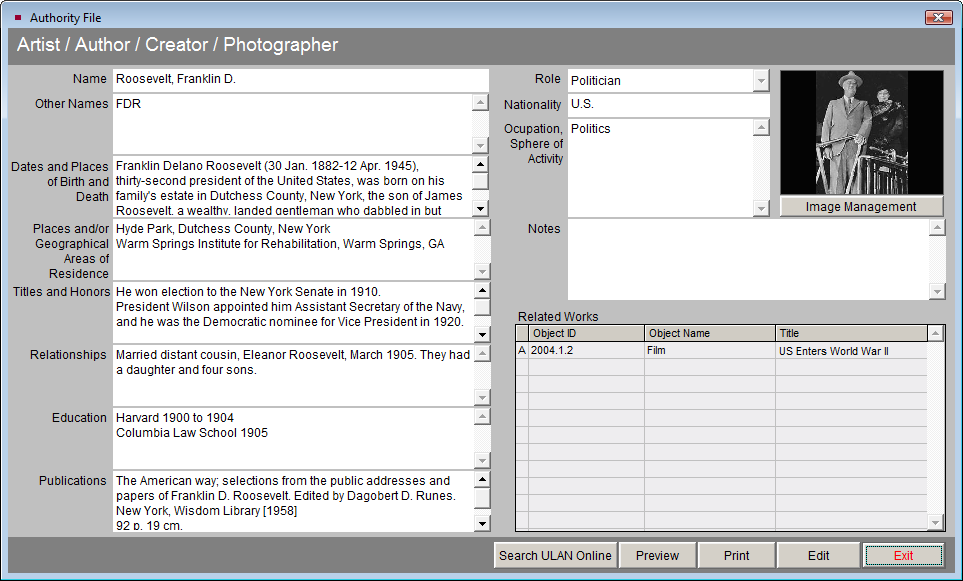
Other Creators - Enter the names of any other creators associated with the unit of description. Enter names: Last, First, Middle Initial to facilitate research.
Administrative/Biographical History - Provide a history of the corporation, or a biography of the creator of the archival material. This will help place the material in context. Record any significant information on the origin, progress, development, and work of the corporation or on the life and work of the creator of the material.
Archival History - Record the successive transfers of ownership, responsibility and/or custody of the unit of description. Indicate any actions, such as history of arrangement, creation of finding aids, re-use, software migration or reorganization of records that have resulted in its present structure and arrangement.
The Structure Tab
This tab provides information about future additions to or destruction of materials, and a guide to the arrangement of the materials.
Archives Structure tab
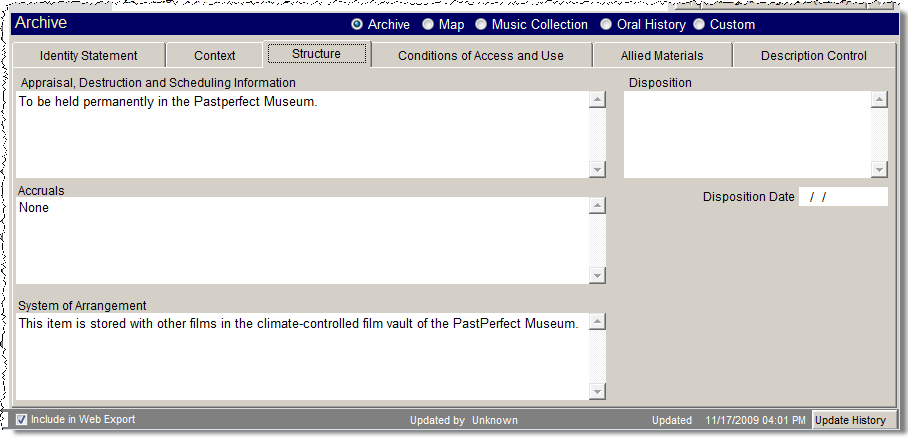
Appraisal, Destruction, and Scheduling Information - Enter information on any appraisal, destruction, or scheduling action taken. Where appropriate, record the authority by which the action has been taken. Example: "This item is to be kept permanently in the PastPerfect Museum Archives. The item shall be appraised every ten years for insurance purposes."
Accruals - Detail any possible changes in the extent of the materials or item. Indicate if future accruals, additional transfers, or deposits are expected. Where appropriate, give an estimate of their quantity and frequency. This field applies to the cataloging of corporate records.
System of Arrangement - Enter information in this field about the arrangement of the material. Specify the order of the materials and, if appropriate, how these have been altered by the archivist.
Disposition - Enter the type of disposition planned for this record, such as "Return to creator" or "Destroy."
Disposition Date - Record the date when the archival items were disposed.
The Conditions of Access and Use Tab
This tab contains fields that are designed to record the legal status of the materials and to outline conditions under which the material may be used or reproduced.
Archives Catalog Conditions of Access and Use tab
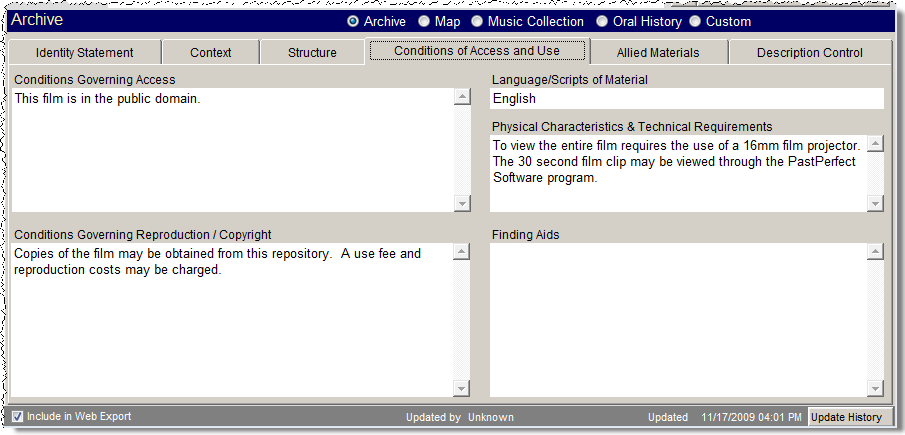
Conditions Governing Access - Identify any conditions that restrict or affect access to the item. Indicate the extent of the period of restriction and the date at which the material will open. Example: "Family correspondence closed until 2020."
Conditions Governing Reproduction/Copyright - Identify any restrictions on the use or reproduction of the material. If the conditions governing the use, reproduction, or publication of the material are unknown, or if there are no conditions, then no statement is necessary.
Language/Scripts of Material - Record the predominant language(s) of the materials comprising the item. If documents contain multiple languages, please list all applicable languages separated by forward slashes.
Physical Characteristics & Technical Requirements - Indicate any important physical details and any permanent physical condition of the material that limits its use.
Finding Aids - Give information about any finding aids that the repository may have that provide information relating to the item. If appropriate, include information on where to obtain a copy. Example: "See: Guide to Historical Document Holdings in Spokane County. 1999."
The Allied Materials Tab
This tab provides fields for recording information about the location of the original item and any information about the existence of copies or other materials that are related and that may be held in other repositories.
Archives Catalog Allied Materials tab
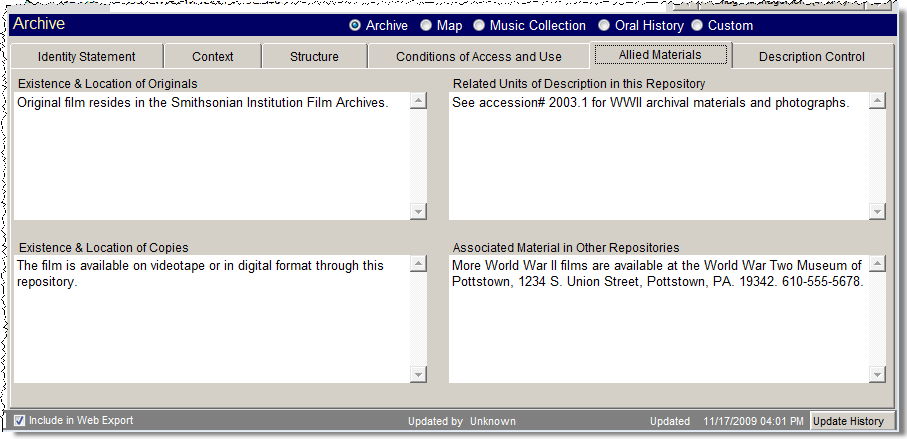
Existence & Location of Originals - If the item is a reproduction and another repository holds the original, record the name of the other repository. Also give any identifying numbers and other information that may help in locating the original material. If the original no longer exists, give that information.
Existence & Location of Copies - If the item is available in another format, record the formats together with any significant Object ID numbers and the location where they may be found. Example: "Photocopies available for researchers. File Cabinet 4 Drawer 2."
Related Units of Description in this Repository - Use this field to identify related items in the same repository. If the item consists of material that has a direct and significant connection to another item in your repository, indicate the relationship. For example: "See Series 2003.1.2 for World War II correspondence from/to Hanley, Warren T. See also 2004.1.1 for his War Ration Book."
Associated Material in Other Repositories - If there is any material in another repository that has a relationship by provenance to the material, provide information about the associated items and the other repository. Example: "Cheney Museum of History owns the diaries of Hanley, Warren T. See Catalog #85.1.2."
The Description Control Tab
Archives Catalog Description Control tab
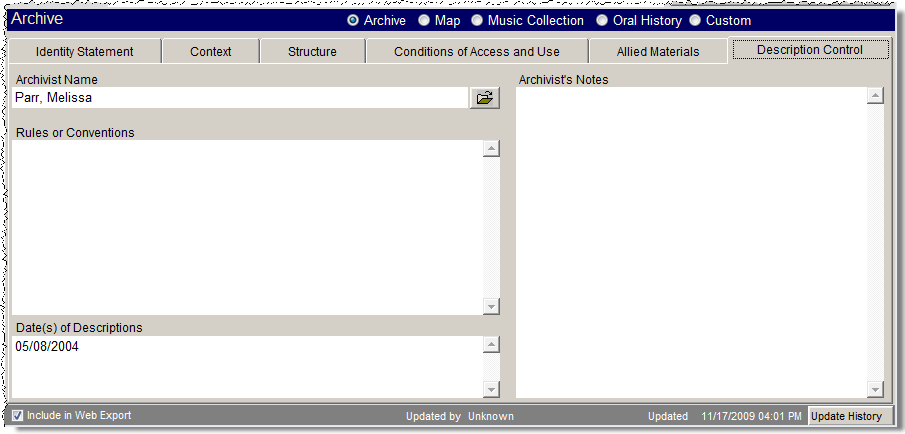
Archivist Name - Record the name of the archivist who is primarily responsible for cataloging and describing the unit of description. This field is controlled by the Experts authority file. To view more information about this expert, click on the file folder icon to the right of the field.
Rules or Conventions - Identify the international, national, and/or local rules or conventions followed in preparing the description.
Date(s) of Description - Indicate when this material was prepared and/or revised.
Archivist's Notes - Explain how the description was prepared.